 English
 عربى
عربى 简体中文
简体中文
Energy & Comfort — Field Notes
The Real Cost of Staying Cool
A close reading of how air coolers and air conditioners actually spend electricity — measured in watts, dollars, and the quiet hum of a summer evening.
An air cooler typically consumes 60 to 90 percent less electricity than an air conditioner cooling the same space. A standard unit draws between 100 and 300 watts; a comparable air conditioner draws 900 to 1,500 watts. Over a full cooling season, that gap can mean hundreds of dollars saved — but the comparison is never just about numbers on a spec sheet.
Air coolers and air conditioners cool a room through fundamentally different physics. One relies on evaporation, a process as old as a damp cloth in open wind. The other relies on mechanical refrigeration — compressing gas, releasing heat, repeating the cycle thousands of times an hour. Understanding this difference is the key to understanding why one appliance sips power while the other drinks deeply.
How Much Electricity Does an Air Cooler Actually Use?
Most residential air coolers fall between 45 watts for small personal units and roughly 250 watts for large tower models. A typical mid-size unit for a bedroom or living room draws close to 150 watts — comparable to two or three incandescent bulbs burning at once. This is possible because an air cooler's only significant power draws are a fan motor and a small water pump. There is no compressor, no refrigerant, no condenser coil doing heavy mechanical work.
A compressor is the single largest power consumer in any air conditioning system — and the single reason air coolers use so little energy by comparison.
A 1-ton split air conditioner, common in many homes, draws approximately 1,000 to 1,200 watts during active cooling. A 1.5-ton unit can pull 1,500 watts or more. This one structural difference — compressor versus fan-and-pump — explains nearly the entire gap in energy consumption between the two technologies.
Air cooler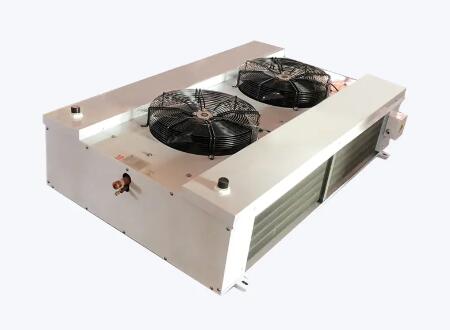
What Is an Evaporative Air Cooler, Exactly?
To understand the energy gap fully, it helps to answer a basic question: what is an evaporative air cooler? It is a device that draws warm ambient air through water-saturated cooling pads. As air passes through the damp pads, water evaporates, and that evaporation absorbs heat from the air — releasing a stream of cooler, slightly more humid air into the room. The entire process relies on a natural physical phenomenon rather than a mechanical refrigeration cycle, which is precisely why the electrical load stays so low.
Because evaporative cooling depends on airflow and water evaporation rather than compressed refrigerant, only a few components require power:
- A fan motor that pulls air through the cooling pads and pushes it into the room
- A small water pump that keeps the cooling pads consistently moist
- In some models, an oscillation motor and a digital control panel, which add negligible wattage
Note
Evaporative cooling performance is highly dependent on humidity. In dry climates, an air cooler can lower room temperature by 10 to 15°F efficiently. In humid climates, the air is already saturated with moisture, so evaporation slows and cooling efficiency drops.
Air Cooler vs Air Conditioner: The Numbers Side by Side
The table below reflects typical power draw, daily running cost, and monthly cost at eight hours of daily use, based on a national average electricity rate of $0.15 per kilowatt-hour.
| Appliance | Average Power Draw | Daily Cost (8 hrs) | Monthly Cost (30 days) |
|---|---|---|---|
| Personal Air Cooler | 50–80 W | $0.06 | $1.80 |
| Mid-Size Room Air Cooler | 150 W | $0.18 | $5.40 |
| Large Tower / Industrial Air Cooler | 250 W | $0.30 | $9.00 |
| Window Air Conditioner (1 ton) | 1,000–1,200 W | $1.32 | $39.60 |
| Split Air Conditioner (1.5 ton) | 1,500 W | $1.80 | $54.00 |
Based on these figures, a household running an air cooler instead of a split air conditioner for an entire summer could save roughly $45 to $50 per month, or several hundred dollars across a three- to four-month cooling season. This is one of the clearest financial arguments in favor of air coolers, particularly for people cooling a single room, a home office, or a garage rather than an entire house.
Extreme Speed Air Coolers: More Airflow, Modest Extra Cost
In recent years, manufacturers have introduced higher-output models often marketed as an extreme speed air cooler, engineered to move a much larger volume of air per minute than a standard unit. These models typically feature more powerful fan motors, larger cooling pad surface areas, and multiple speed settings capable of reaching airflow rates of 3,000 to 5,000 cubic feet per minute. Naturally, this raises a fair question: does higher speed mean significantly higher energy consumption?
The answer is a modest increase, not a dramatic one. An extreme speed air cooler generally draws between 200 and 280 watts at its highest setting, compared to 150 watts for a standard mid-size unit — roughly a 30 to 60 percent increase. That remains far below even the lowest-consuming air conditioner. In practical terms, running an extreme speed air cooler for eight hours a day might add only $2 to $4 to your monthly bill compared to a standard model, while delivering noticeably stronger airflow and faster cooling in larger, open-plan spaces.
Slim Air Coolers: Built for Small Spaces, Lower Wattage
Another popular category is the air cooler slim design — built for tight spaces such as apartments, dorm rooms, or narrow home offices where a bulky unit simply won't fit. These slim towers use a smaller footprint and lighter internal components, typically resulting in lower power consumption than standard boxy coolers, in the range of 65 to 120 watts.
The trade-off is cooling capacity rather than efficiency. A smaller fan and reduced pad surface area mean these units are best suited to personal zones of roughly 100 to 150 square feet, rather than whole-room cooling. For someone prioritizing low energy use and space efficiency over maximum output, a slim air cooler is an excellent middle ground — using even less electricity than a standard unit while still outperforming a basic desk fan in real temperature reduction.
Are "As Seen on TV" Air Coolers Actually Efficient?
Many shoppers first encounter portable evaporative coolers through infomercial-style marketing, often branded generically as an air cooler as seen on tv product. These compact, personal-use units are usually USB-powered or run on very low wattage — often 5 to 25 watts — making them the least power-hungry cooling devices on the market. Their energy cost is nearly negligible, often less than a dollar per month even with regular use.
Manage expectations
These ultra-low-wattage units are designed for personal, close-range cooling — a desk or a bedside table — not for cooling an entire room. Their tiny water tanks and small fans cannot move enough air or evaporate enough water to lower the temperature of a larger space.
If your goal is personal cooling with minimal energy draw, these products can genuinely work. If you need whole-room comfort, a standard or extreme speed air cooler will deliver far better results — still at a fraction of an air conditioner's running cost.
Calculating Your Own Monthly Running Cost
To estimate your own running costs, use this simple sequence:
- Find the wattage listed on the unit's nameplate or spec sheet
- Divide the wattage by 1,000 to convert it to kilowatts
- Multiply by the number of hours you run the unit daily
- Multiply that figure by your local electricity rate per kilowatt-hour
- Multiply by the number of days in your billing cycle for a monthly estimate
For example, a 150-watt air cooler running 10 hours a day at $0.15 per kWh costs approximately $6.75 per month. Applying the same formula to a 1,200-watt air conditioner over the same hours yields a monthly cost closer to $54 — a difference that grows even larger in regions with higher electricity rates or during extended heat waves, when units run for longer daily periods.
Takeaway
Even doubling your air cooler's daily runtime rarely approaches the monthly cost of running an air conditioner on a modest schedule. The gap is structural, not incidental.
Other Factors That Quietly Affect Consumption
While wattage is the primary driver of energy cost, several other factors influence how much electricity your cooling device consumes over time:
- Fan speed setting — running on high consumes noticeably more power than low or medium
- Room ventilation — air coolers need fresh air exchange to function efficiently; poor ventilation forces longer run times
- Climate humidity — higher humidity reduces evaporative efficiency, sometimes prompting longer runtimes for the same comfort
- Water pump cycling — continuous pump operation adds a small but steady load compared to intermittent cycling
- Maintenance — clogged or mineral-crusted cooling pads force the fan motor to work harder, slightly raising consumption
Don't skip maintenance
Neglected cooling pads are the most common reason an air cooler's real-world energy use drifts above its rated wattage. Clean pads and reservoirs monthly during heavy use.
Matching the Technology to the Climate
Energy consumption is only one part of the decision, but it is often the deciding factor for budget-conscious households, renters paying their own utilities, or anyone mindful of their environmental footprint. If your climate is hot and dry, and you're cooling a single room or personal space, an air cooler offers substantial savings without a major sacrifice in comfort. If you live somewhere humid, or need to cool a large, sealed living space, an air conditioner's higher running cost may be justified by its consistent, humidity-independent performance.
For many households, the most sensible approach isn't choosing one technology exclusively — it's matching the right device to the right space: a slim or personal evaporative unit for a bedroom, an extreme speed model for a larger living area, and air conditioning reserved for the hottest, most humid days of the year. This layered approach can meaningfully reduce an overall electricity bill while keeping every room comfortable through the season.
In Summary
The physics is simple even when the marketing isn't: evaporation is cheap, compression is expensive. An air cooler's fan-and-pump design will almost always cost less to run than an air conditioner's compressor, often by a wide margin — sometimes ten times less on the monthly bill. The right choice depends less on which technology is "better" and more on your climate, your room size, and how much of the house you actually need to cool. Understood clearly, that decision becomes far easier — and considerably cheaper.
.jpg?imageView2/2/w/300/h/300/format/webp/q/75)