 English
 عربى
عربى 简体中文
简体中文
Field Engineering Note · Condenser Sizing
A refrigeration plant at 2,800 m above sea level expected its air-cooled condenser to match the datasheet. It did not — because the datasheet was written at sea level.
Altitude changes the one thing an air-cooled condenser depends on most: the air itself. A condenser rated in a lowland factory loses a measurable fraction of its heat-rejection capacity as soon as it operates where air is thinner. This is the altitude derate, and it should be settled before a compressor, a fan motor, or even a pipe size is chosen.
In practical terms, expect roughly a 3–5% loss of condenser capacity for every 1,000 m of elevation gain. A sea-level selection of 200 kW of heat rejection at 2,000 m may deliver only 180–185 kW, and less still at higher elevations. The immediate symptoms are a rising condensing temperature, a climbing discharge pressure, and a compressor that burns more energy for less refrigeration.
Why Altitude Changes Condenser Capacity
An air-cooled condenser is a heat exchanger with a fan. The fan moves a volume of air across finned tubes, and the coil rejects heat to the air that actually passes over it. At 2,000 m, a cubic meter of air weighs roughly 18% less than at sea level. The fan still moves the same cubic meters per hour, but each cubic meter carries fewer air molecules to absorb heat.
Lower air density reduces the air-side heat-transfer coefficient and the mass flow of air per fan revolution at the same time. Both effects push in the same direction: the condenser must develop a higher temperature difference to reject the same heat load, or the condensing pressure rises against every downstream component.
A sound field rule is to apply a 3–5% capacity correction for every 1,000 m of elevation, and then to confirm the exact factor with the coil manufacturer before the order is placed.
At 2,000 m, a typical air-cooled condenser retains only 89–92% of its sea-level capacity.
Putting Numbers on the Derate
The table below gives representative ranges for standard fin-and-tube air-cooled coils. The values combine the effect of lower air mass flow with lower air-side heat transfer; specific products differ in circuiting, fin density, and tube pattern.
| Altitude (m) | Air density ratio vs. sea level | Typical capacity retained | Derate to apply |
|---|---|---|---|
| 0 | 1.00 | 100% | None |
| 1,000 | 0.91 | 96–95% | 4–5% |
| 2,000 | 0.82 | 92–89% | 8–11% |
| 3,000 | 0.74 | 87–83% | 13–17% |
| 4,000 | 0.67 | 84–79% | 16–21% |
At 3,000 m — a realistic elevation for mining and food-processing plants in the Andes, Central Asia, and western China — ignoring the altitude derate of a sea-level selection raises condensing temperatures by roughly 6–10 K above prediction, with a matching loss of system capacity and efficiency.
The Fan Is Part of the Correction
Fans are volume machines. At altitude they move nearly the same cubic meters per hour, but the mass of air delivered drops with density, and so does fan power. A motor that is comfortably loaded at sea level is rarely overloaded at elevation; the more subtle risks are motor cooling and the fan curve itself. An air-over motor at low air density removes less heat from its own windings, and the same static pressure no longer produces the same airflow when the air is lighter.
Because fan power falls more slowly than condenser heat-transfer capability, net system efficiency drops rather than improves. Variable-speed fans help the unit follow cold-night operation and part-load conditions, but they do not replace the derate correction.
Design tip: if the selection pushes the temperature difference between condensing and entering air above roughly 15 K for an air-cooled unit, the coil surface is undersized for the altitude. More fan speed is not the fix.
What to Change When Sizing for Elevation
The starting point is to request the manufacturer's altitude correction factor and apply it to the required capacity before anything else. From there, the sequence follows a pattern that experienced refrigeration designers will recognize.
- Apply the manufacturer's altitude factor to the condenser capacity — never rely on a generic rule of thumb for the final selection.
- Increase the coil surface, through larger face area or additional rows, until the corrected capacity matches the design heat load.
- Re-select the fan and motor at the site's air density, and confirm motor cooling is adequate at the installed elevation.
- Recheck the air-side pressure drop at the lower density and read the fan curve at site conditions rather than at sea-level values.
- Revisit the complete condensing unit — compressor, expansion device, receiver, and refrigerant charge — because the circuit behaves differently at a higher condensing temperature.
- Ask the manufacturer for recorded examples of similar high-altitude installations and for the commissioning data that confirmed the selection.
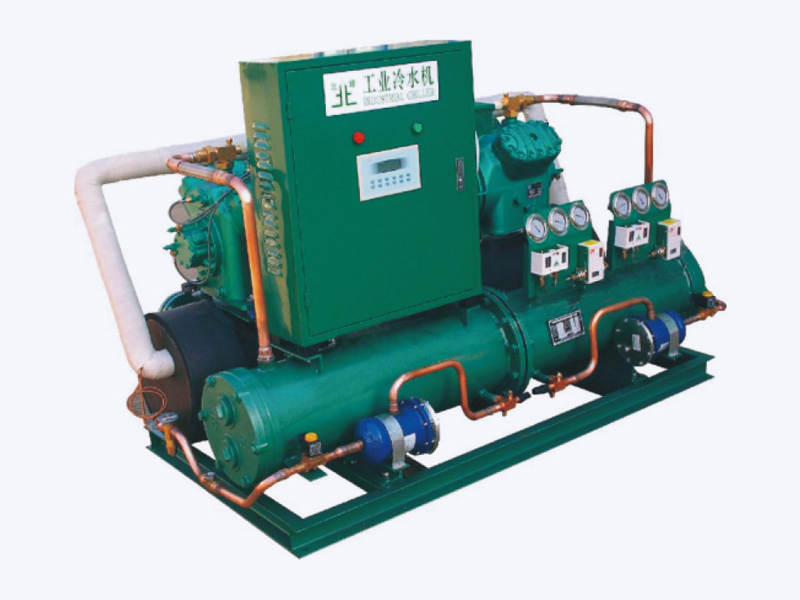
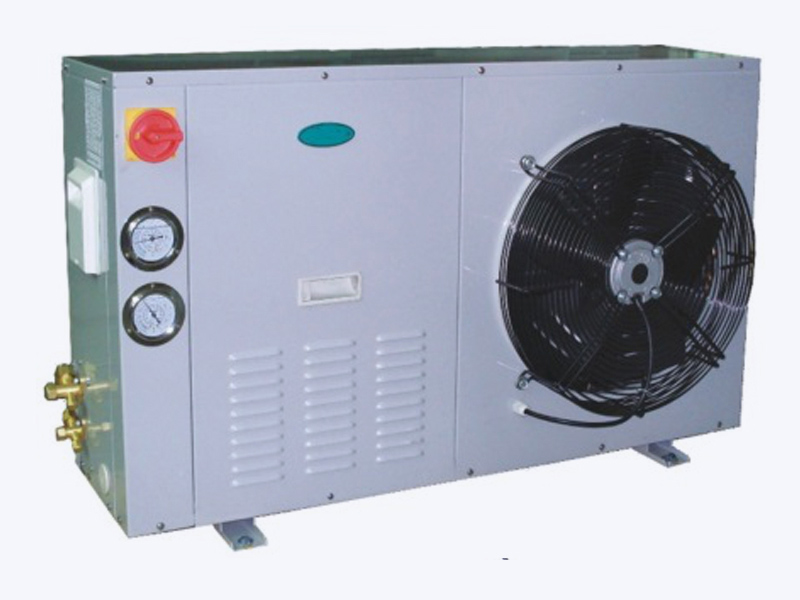
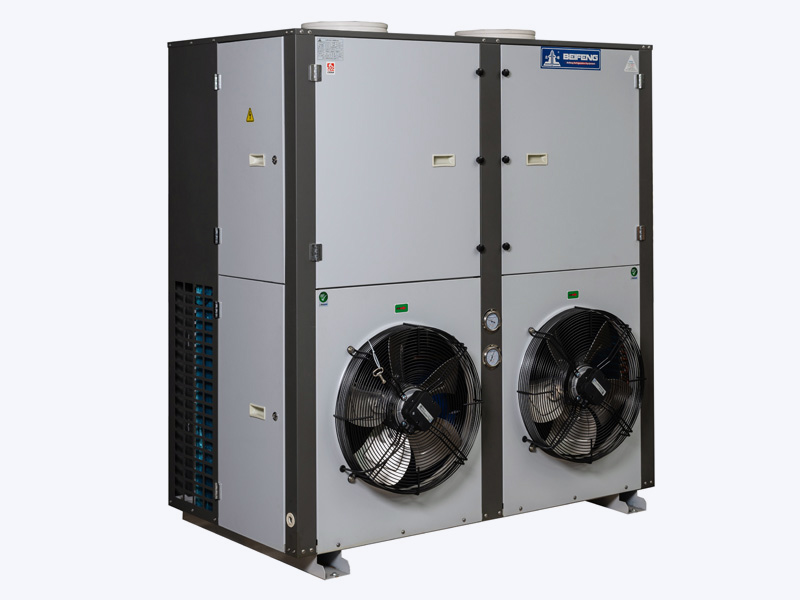
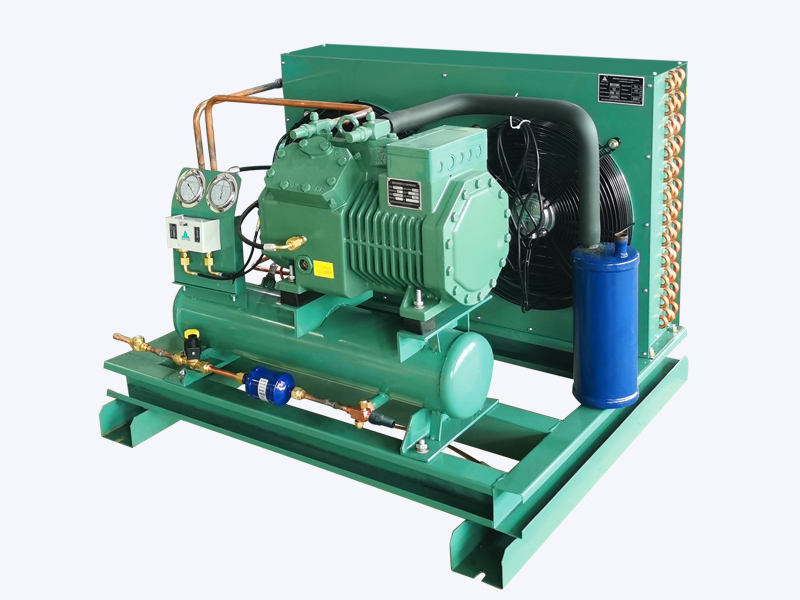 Semi-Hmetic Air-Cooled Condensing Unit for High AltitudeThis semi-hermetic condensing unit suits a range of refrigerants and includes key controls. Its air-cooled coil can be altitude-corrected to maintain reliable operation at plateau conditions.View Product →
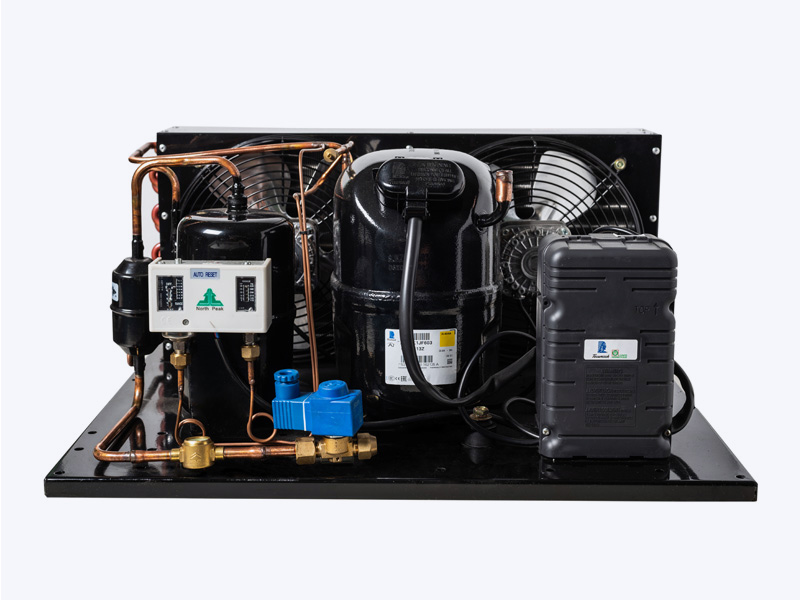
For packaged systems, the same discipline applies at the unit level. When you compare how to choose air-cooled condensers, a model with an altitude-corrected coil keeps the discharge-pressure envelope and the compressor service factor well inside their limits for years, instead of tripping on high pressure on the first hot afternoon of the plateau summer.
Warning: do not compensate for altitude by increasing fan speed alone. The loss lives in the coil's heat-transfer capability and in air mass flow. Overspeeding raises noise and motor temperature while the condenser remains short of capacity.
Beyond the Condenser: Whole-System Effects
The condenser derate does not stay inside the condenser. A higher condensing temperature raises the compression ratio, which lowers volumetric efficiency, raises discharge temperature, and increases specific power consumption. The evaporator then delivers less cooling even though it sits in a normal indoor environment — the penalty travels through the refrigerant circuit.
This is why altitude corrections should be applied to the condenser and checked against the entire condensing unit's operating envelope. At 2,500 m, a unit that runs just a few degrees higher in condensing temperature can lose 5–8% of net cooling capacity while drawing more power — a double penalty that appears on every monthly energy bill.
Danger: commissioning an uncorrected system at altitude risks repeated high-pressure trips, oil degradation, and premature compressor wear. The failure is not always immediate — it erodes reliability quietly until the first hot season exposes it.
High-Elevation Projects and Engineering Support
Cooling equipment travels far beyond the factory floor. Condensing units end up in highland processing plants, mines, and cold stores from the Andes to the Ethiopian highlands, from the plateau cities of Central Asia to the mountain provinces of western China. Everywhere above 1,000 m, the local air density changes the answer — and the datasheet must be corrected before the equipment is built, not after it arrives on site.
Above that elevation, condenser selection stops being a catalogue lookup. A manufacturer with heat-exchange and packaged-unit experience matters, because the correct derate touches coil geometry, fan design, motor margins, and the unit's pressure controls as a single system. For industrial cold stores and processing facilities, screw-type condensing units carry the larger loads, and the same altitude factor applies to every coil in the plant.
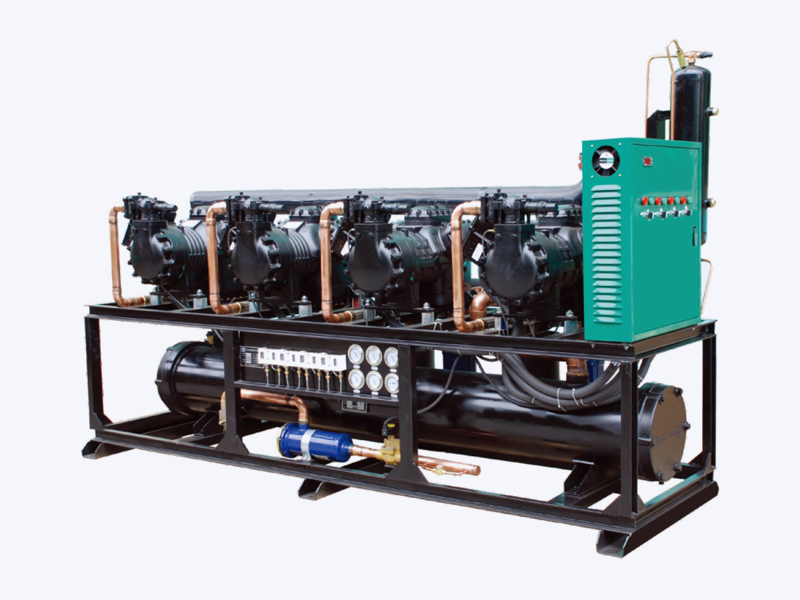
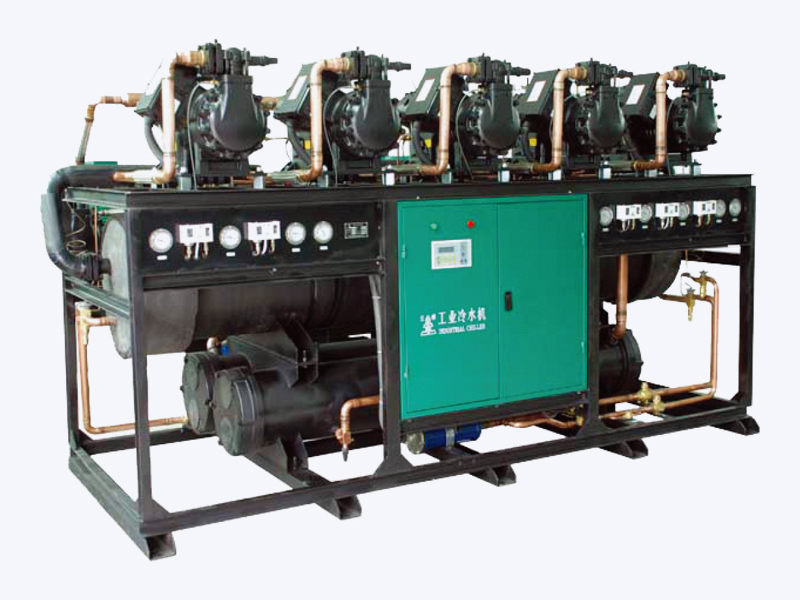
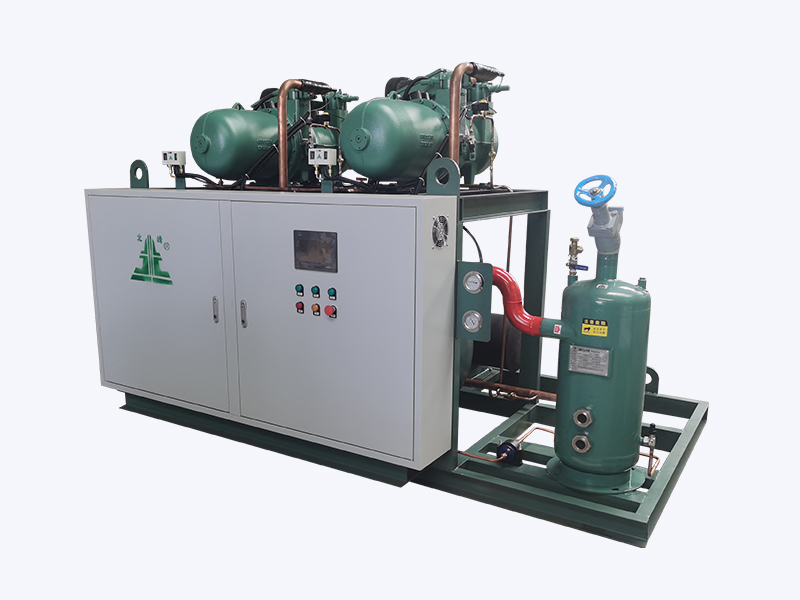 Screw-Type Condensing Unit for Large Industrial LoadsScrew-type condensing units handle larger refrigeration loads and must be derated at high elevation. Look for models with altitude-corrected coils and fan selection to preserve performance at site air density.View Product →
Success measure: a correctly factored air-cooled condenser at 3,000 m holds the same condensing-temperature envelope as its sea-level twin. The only visible difference is a slightly larger coil and a properly sized fan motor.
The Bottom Line
Altitude is not a footnote in condenser sizing; it is a fundamental input. Air density at 2,000 m is roughly 18% lower than at sea level, and the practical derate of an air-cooled condenser spans about 4% at 1,000 m to as much as 20% at 4,000 m. Apply the manufacturer's correction, increase the coil surface accordingly, re-select the fan at the site density, and verify the condensing unit's full operating envelope.
Designers and contractors who handle this well avoid the most common high-elevation complaint: a system that starts smoothly in cool weather and loses head-pressure control as soon as the ambient peaks in the afternoon. The last and most useful step is to ask the factory's engineering team for an altitude-corrected selection before committing to the order.
.jpg?imageView2/2/w/300/h/300/format/webp/q/75)