 English
 عربى
عربى 简体中文
简体中文
Design Engineering
Air Cooled Condenser Design Code: What Actually Governs the Coil, the Frame and the Rating
Performance rating, pressure equipment and site standards are three separate rule sets. Knowing which one answers which question is what keeps a condenser project out of re-rating.
An air-cooled condenser that clears review in one market can be rejected in another with the coil drawing unchanged. What changed is the code basis. Capacity is published under a rating standard, the coil and receiver are built to a pressure equipment regime, and the installation is checked against local structural, electrical and refrigerant rules. Three sets of documents, written by three sets of committees, and the hand-offs between them are where projects lose capacity, approvals, or both.
The sequence that works is short. Fix the rating standard and its reference conditions. Then fix the pressure design code and the design pressure. Then fix the site loads. Fin spacing, fan selection, coating, sound treatment and control strategy all follow from those three decisions. Reverse the order and the likely outcome is equipment that has already been ordered before anyone verifies that the published capacity applies to the roof it is going on.
Three Code Layers Behind Every Air Cooled Condenser
Separating the documents by what they can actually decide makes a specification far easier to review. A rating standard explains how a published number was produced. A pressure code sets how thick the tube must be and how the assembly is verified. A site standard decides whether the unit may be installed where it was planned.
- Performance rating: AHRI 460 in North America, EN 327 test methods in Europe. These fix entering air temperature, condensing temperature, refrigerant and fan power.
- Pressure equipment and refrigerant safety: ASME BPVC Section VIII Division 1, EN 13445 or GB/T 150 for the pressure envelope, with ASHRAE 15, ISO 5149 or EN 378 governing the system around it.
- Installation and site: wind and seismic loading, corrosion category, electrical safety, noise limits and local permits.
A submittal that quotes capacity without naming the rating standard is incomplete. So is a coil drawing with no design pressure, no relief device sizing and no defined corrosion system.
Performance Rating Codes: AHRI 460 and EN 327 Set the Comparable Baseline
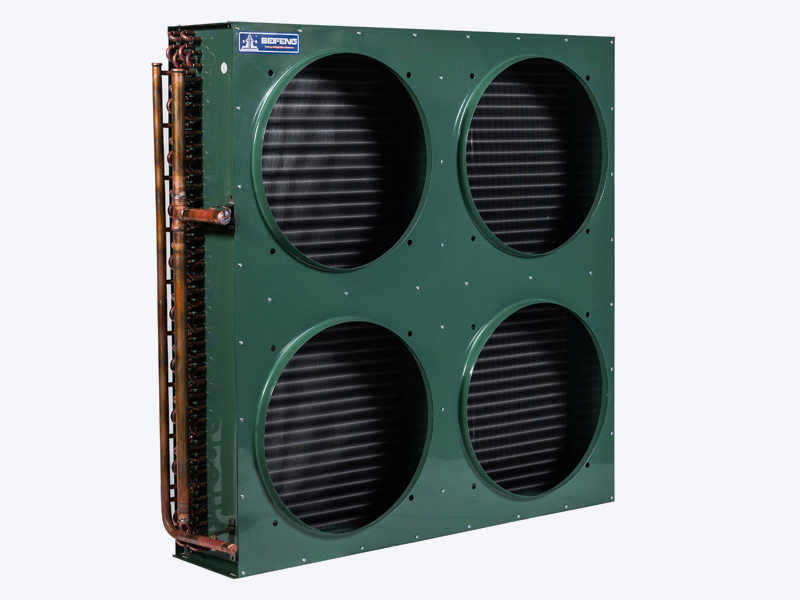
AHRI 460 exists so that two suppliers can be compared honestly. It defines the rating of remote mechanical-draft air-cooled refrigerant condensers, including test conditions and the tolerances permitted on published capacity. EN 327 plays a similar role in Europe as a test method for forced-convection air-cooled refrigerant condensers and dry coolers. Neither standard tells you what a condenser will do on a specific roof, and both tell you exactly what the datasheet number means.
Two reference values do most of the work. Entering air dry-bulb is the ambient the rating is based on, commonly around 35 °C in North American practice and often lower in European dry-cooler ratings. Condensing temperature is the refrigerant-side reference. Capacity rises with the gap between them, so a unit published at a 10 K temperature difference does not behave the same way at 5 K. Heat rejection itself is simpler: the condenser rejects the evaporator load plus compressor power, which places a first estimate at roughly 1.15 to 1.35 times the cooling capacity.
That is why an air cooled condenser selection calculation starts from the written specification rather than a catalogue page, and why the ambient basis should be agreed before any model number is quoted.
Four numbers to request before comparing quotations: entering air dry-bulb, condensing temperature, refrigerant and total fan power. Capacities published without all four cannot be ranked against each other.
Fan power belongs in the same conversation as capacity. Two condensers with the same nominal duty can differ noticeably in fan kilowatts, and that difference runs for every hour of the plant's life. Sound follows the same rule: a figure measured under one method is not comparable with a figure measured under another, so the measurement standard matters as much as the decibel value.
Pressure Part Design: PED, ASME VIII and GB/T 150
The coil is a pressure vessel in everything but name. Header and tube wall thickness, receiver volume, relief device sizing and the test procedure all come from the pressure code chosen for the market. In the European Union, Directive 2014/68/EU classifies components by pressure and volume and requires CE marking through the appropriate conformity assessment route, with EN 13445 as the usual design standard behind it. In the United States, ASME BPVC Section VIII Division 1 does the equivalent work, normally tied to a stamp and a registered design. In China, GB/T 150 governs the design and the manufacturer needs a pressure vessel manufacturing licence, a qualification worth verifying rather than assuming.
Design pressure is a project decision, not a catalogue default. HFC blends such as R404A, R448A and R449A sit in a familiar band. Transcritical CO2 does not, and pushes design pressures far higher, which changes tube gauge, header geometry, relief device selection and test pressure. A condenser built for an HFC system is not converted to CO2 by changing the label.
Material certificates, weld procedures, relief set pressures and test records are the first documents an inspector or notified body asks for. Missing paperwork makes a well-performing unit non-compliant.
Structural, Corrosion and Electrical Codes Add the Site Rules
Mechanical codes stop at the shell. Wind and seismic loading, base frame stiffness, anchorage detail and roof curb design come from the building code of the location: ASCE 7 and the IBC in the United States, Eurocode 1 and Eurocode 8 in Europe, and equivalent national codes elsewhere. Coastal and industrial sites add a corrosion category under ISO 12944, which normally means a heavier coating system, aluminium or stainless fin stock, and a cleaning schedule matched to the exposure.
Electrical and control compliance runs in parallel: IEC or UL 60335-2-40 for the appliance, local disconnect and short-circuit ratings, and refrigerant detection where charge quantity and occupied volume require it under ASHRAE 15, ISO 5149 or EN 378.
Clearance and recirculation problems cannot be repaired with a better coil. If discharge air re-enters the coil face, the rated capacity is gone no matter which standard the datasheet cites.
Site Conditions the Codes Do Not Fix For You
Standards provide the framework; they do not provide your weather. These decisions stay with the designer, and each one moves the final selection:
- Design ambient dry-bulb, chosen for realistic operating hours rather than a once-in-fifty-years peak applied to every hour of the year.
- Altitude, which lowers air density and mass flow, so published capacity needs correction above sea level.
- Recirculation and clearance, since warm discharge air pulled back into the coil face removes part of the rated duty.
- Fouling, dust and pollen, which argue for wider fin spacing and a cleaning route maintenance can actually follow.
- Noise limits at the nearest receptor, which may favour larger coils at lower fan speed over acoustic treatment.
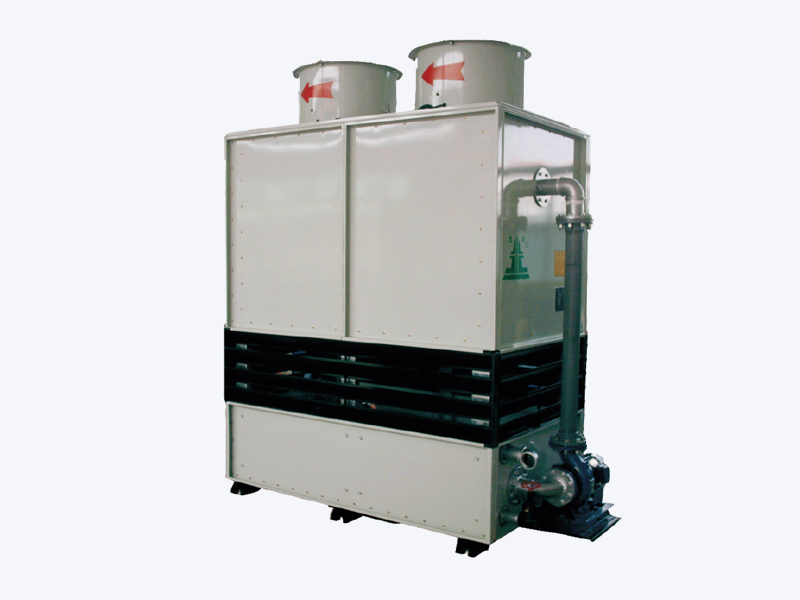
- Water availability, which decides whether an adiabatic or evaporative assist belongs in the design at all.
A code-compliant condenser on the wrong roof is still the wrong condenser.
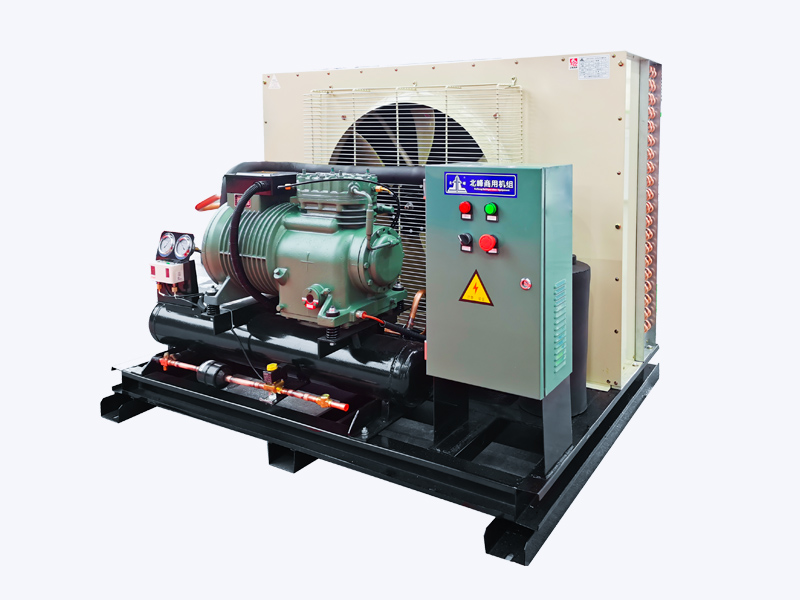
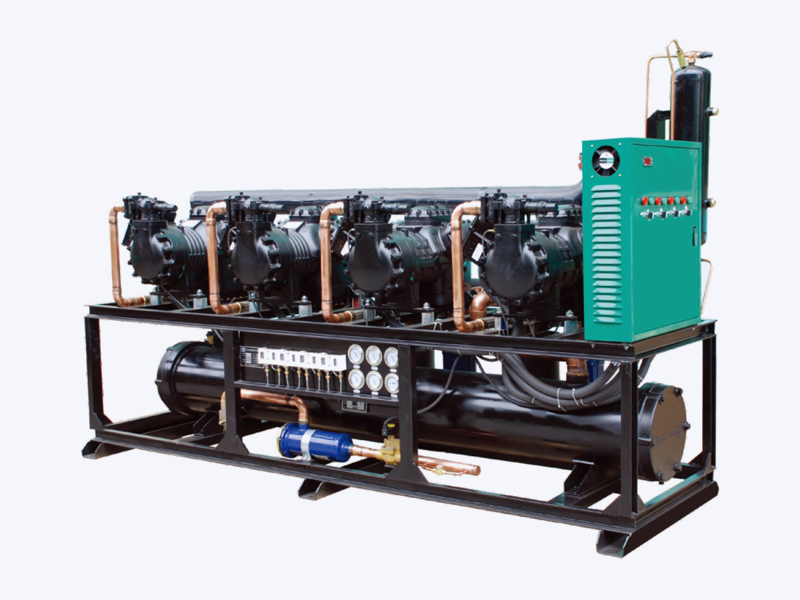
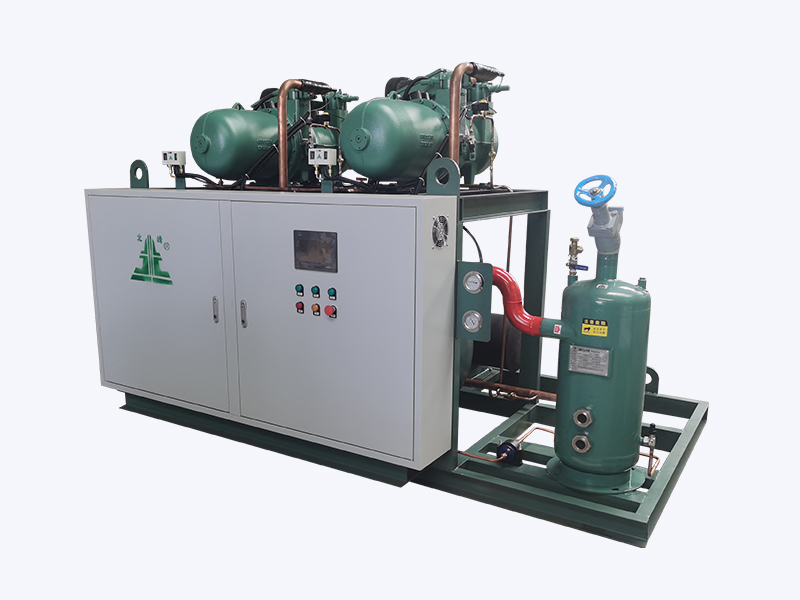
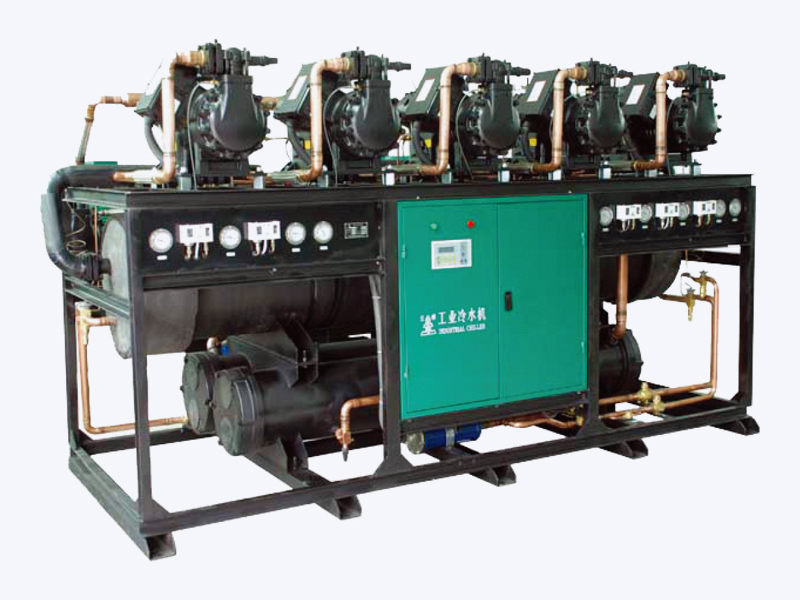
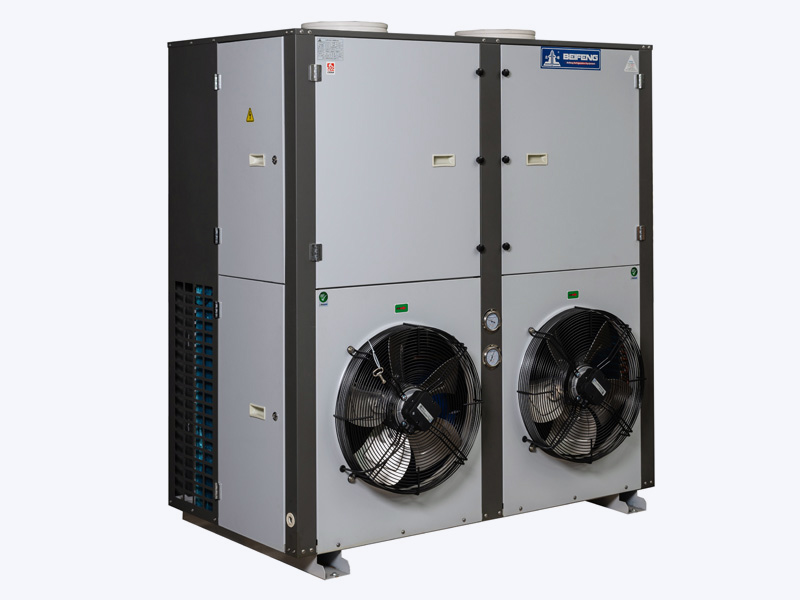
Industrial duty magnifies each of these. Large screw-based condensing units for process cooling and cold storage are usually specified on part-load behaviour, service access and structural loading as much as on nominal capacity, and a compliant rating does not compensate for a base frame sized for a lighter machine.
How the Same Coil Gets Different Approvals
The same condenser drawing is often reviewed against more than one regime at the same time, especially on export projects where the specifier, the insurer and the local authority each reference a different document.
| Market | Rating basis | Pressure equipment | Refrigerant safety |
|---|---|---|---|
| European Union | EN 327 test methods | PED 2014/68/EU with EN 13445 design | EN 378, with HFC phase-down rules |
| North America | AHRI 460 | ASME BPVC VIII Div. 1, CRN in Canada | ASHRAE 15, with AIM Act phase-down |
| China | GB/T heat exchanger test standards | GB/T 150 with a pressure vessel manufacturing licence | National refrigeration safety rules |
| Gulf and Southeast Asia export projects | Usually AHRI 460 or EN 327, as specified | ASME or PED, depending on the consultant | ASHRAE 15 or EN 378, as specified |
Retail Applications Where the Codes Bite Hardest
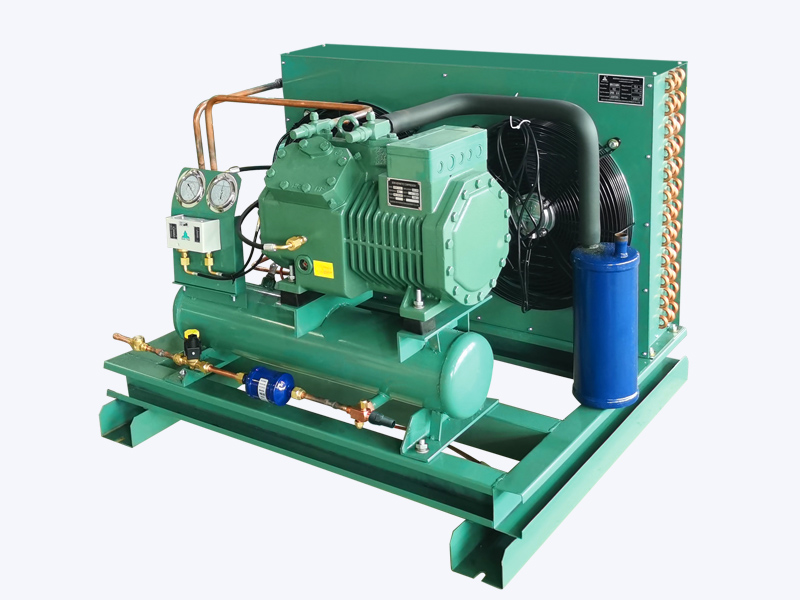
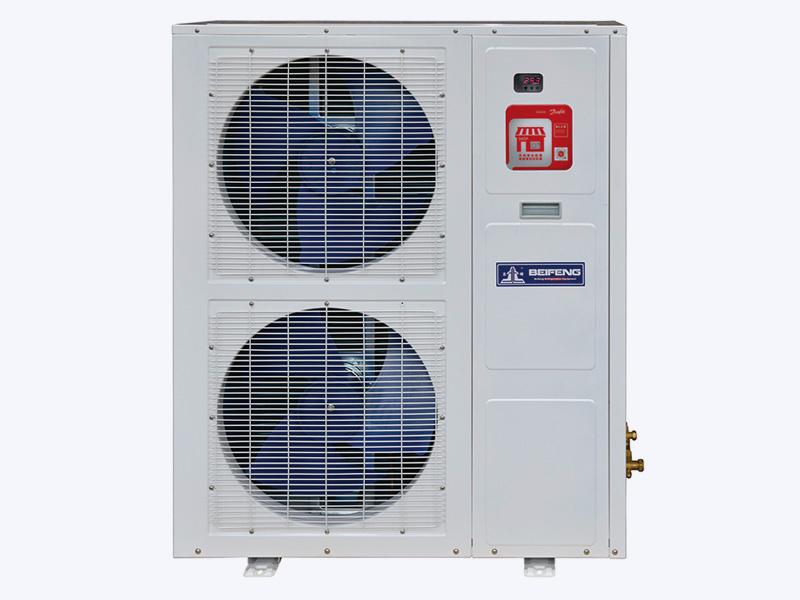
Supermarket and convenience-store refrigeration is where code pressure is most visible, because refrigerant charge, leak tightness, energy labelling and HFC phase-down all land on the same equipment at once. Medium-temperature inverter condensing units are typically chosen on part-load efficiency and pull-down behaviour rather than a single peak figure, and the refrigerant permitted in the region usually decides the pressure design before the coil is drawn.
A Compliance Checklist for the Drawing Package
- Rating standard named, with entering air dry-bulb, condensing temperature, refrigerant and fan power.
- Design pressure and pressure code stated, including relief device sizing and set pressure.
- Tube and header gauges, material specifications and the corrosion system for the ISO 12944 category of the site.
- Wind, seismic and anchorage loads taken from the local building code.
- Electrical compliance route and control voltage defined.
- Refrigerant charge, leak detection and ventilation calculated under the applicable safety standard.
- Test records: leak test method, pressure test and performance verification.
A package that answers these seven points in order is usually approved without a second round of comments, because every reviewer question has already been anticipated.
Air cooled condenser design code is not one document to look up. It is a sequence: rating basis first, pressure design second, site conditions third, and the paperwork that proves all three. Projects that follow the sequence spend their time on optimisation. Projects that reverse it spend their time on re-rating, re-certification and delay.
For anything beyond a repeat order, the cheapest moment to settle the rating standard and the design pressure is while both are still negotiable. If the specification is still open, it is worth talking to the engineers who build the equipment before the model number is fixed.
.jpg?imageView2/2/w/300/h/300/format/webp/q/75)