 English
 عربى
عربى 简体中文
简体中文
Cooling Systems & Performance
Air Cooler vs. Air Conditioner: A Real Comparison of Cooling Power
Two technologies, two philosophies of comfort. One bends water into breeze; the other bends physics into chill. Here's how they actually measure up, room by room, climate by climate.
Air Conditioners Deliver Stronger Cooling Power, But Air Coolers Are Effective in the Right Conditions
The direct answer is that a traditional air conditioner provides significantly stronger and more consistent cooling power than an air cooler, typically lowering room temperature by 15°F to 20°F (8°C to 11°C) regardless of outdoor humidity. An air cooler, by contrast, can only lower temperature by roughly 5°F to 15°F (3°C to 8°C), and its effectiveness depends heavily on how dry the surrounding air is. In hot, arid climates, a well-sized air cooler for bedroom use can feel nearly as refreshing as air conditioning, but in humid regions its cooling power drops sharply.
Air conditioners win decisively on raw cooling power and consistency across all climates, while air coolers offer advantages in energy efficiency, upfront cost, and ventilation-friendly operation.
The rest of this article breaks down exactly how these two cooling methods compare, where each performs best, and how to decide which one suits your space.
How Each Technology Actually Cools the Air
Understanding the fundamental mechanics behind each system explains why their cooling power differs so much in practice.
Air Conditioners Use Refrigeration Cycles
A traditional air conditioner uses a compressor, refrigerant, and condenser coils to actively remove heat from indoor air and expel it outside. This closed-loop refrigeration cycle allows the unit to lower temperature independent of outdoor humidity, which is why an AC can maintain a comfortable 72°F (22°C) room even when it is 100°F and humid outside.
Air Coolers Rely on Evaporation
An air cooler, sometimes called a swamp cooler or an outdoor evaporative cooler when used in open-air settings like patios and garages, works by pulling warm air through water-saturated pads. As the water evaporates, it absorbs heat from the air, producing a cooler breeze. This process is highly effective in dry climates but loses much of its power once humidity rises above roughly 60%, since the air is already too saturated to absorb additional moisture efficiently.
air cooler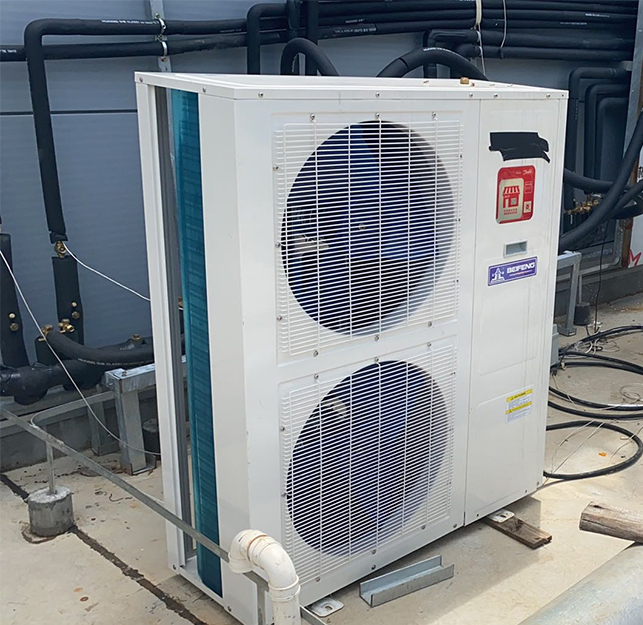
Side-by-Side Cooling Power Comparison
The table below summarizes the practical performance differences between the two systems under typical usage conditions.
| Factor | Air Cooler | Air Conditioner |
|---|---|---|
| Temperature Drop | 5°F - 15°F | 15°F - 20°F |
| Performance in Humidity | Poor above 60% humidity | Unaffected by humidity |
| Ventilation Requirement | Needs open window or airflow | Works in sealed rooms |
| Energy Consumption | Low (100-300 watts) | High (1000-1500 watts) |
| Best Use Case | Dry climates, outdoor spaces | Any climate, sealed indoor rooms |
Why Humidity Is the Single Biggest Factor in Cooling Power
Humidity level is the single most important variable determining whether an air cooler can compete with an air conditioner. In a dry region where relative humidity sits around 20% to 30%, an evaporative cooler can drop room temperature by as much as 15°F, making it a genuinely comfortable option. However, in a coastal or tropical region where humidity regularly exceeds 60%, the same unit might only reduce temperature by 3°F to 5°F, offering little more than a fan's worth of relief.
This is why an outdoor evaporative cooler is particularly popular in dry desert climates for cooling patios, garages, and workshops, where the constant airflow and low humidity allow the evaporation process to work at full efficiency. Air conditioners, by contrast, remove moisture from the air as part of the cooling process, which is why they perform consistently well regardless of the outdoor humidity level.
Room Size and Ventilation Requirements
Cooling power is not only about temperature drop — it is also about how each system interacts with the size and layout of the room being cooled.
- An air cooler for bedroom use performs best in a room of 150 to 300 square feet with at least one window cracked open to allow humid air to escape.
- Without ventilation, an evaporative cooler will raise indoor humidity to uncomfortable levels within an hour, reducing its own cooling effect.
- An air conditioner operates most efficiently in a sealed room, since open windows allow cooled air to escape and force the compressor to work harder.
- Larger rooms above 400 square feet generally require a split or central air conditioning system to maintain consistent cooling power.
Note — running an evaporative cooler in a fully sealed room can backfire, raising humidity instead of easing it.
Energy Efficiency and Running Costs
While air conditioners win on raw cooling power, air coolers hold a clear advantage in energy consumption. A typical air cooler draws between 100 and 300 watts, roughly the same as a few ceiling fans, while a standard window or split air conditioner consumes 1000 to 1500 watts or more depending on size and efficiency rating.
Practical Cost Example
Running an air cooler for 8 hours a day might cost only a fraction of what an equivalent air conditioner would cost over the same period, since the compressor in an AC unit is the primary driver of electricity use. For users prioritizing lower utility bills over maximum cooling power, this efficiency gap is often the deciding factor, especially in moderately warm climates where an air cooler for bedroom use can still provide adequate comfort at night.
Good to know — lower wattage means an air cooler can often run safely on a standard household circuit without any dedicated wiring.
Best Scenarios for Choosing an Air Cooler Over an Air Conditioner
Certain situations make an air cooler the more practical and effective choice, even though it cannot match the raw cooling power of refrigerant-based systems.
- Living in a dry or semi-arid climate where humidity rarely exceeds 50%.
- Cooling semi-outdoor spaces such as patios, garages, or workshops with an outdoor evaporative cooler.
- Needing a portable, low-cost cooling option without professional installation.
- Wanting to reduce electricity bills during moderate heat rather than extreme heatwaves.
- Preferring fresh outdoor air circulation over a sealed, recirculated indoor environment.
When an Air Conditioner Is the Clearly Better Choice
There are also clear scenarios where an air conditioner's superior cooling power makes it the only realistic option.
- Living in a humid climate where evaporative cooling loses most of its effectiveness.
- Needing to cool a sealed room without any window ventilation.
- Requiring precise, consistent temperature control regardless of outdoor conditions.
- Cooling larger spaces above 400 square feet that need stronger, sustained airflow.
Caution — in high-humidity climates, relying on an evaporative cooler alone during peak heat can leave a room both warm and damp.
Final Takeaway on Cooling Power
When comparing raw cooling power, a traditional air conditioner outperforms an air cooler in nearly every measurable way, delivering greater temperature drops regardless of climate or humidity. However, an air cooler for bedroom use in dry regions, or an outdoor evaporative cooler on a patio, can offer meaningful, energy-efficient relief at a fraction of the operating cost. The right choice ultimately depends on your local climate, room ventilation, and whether you prioritize maximum cooling power or lower energy consumption.
.jpg?imageView2/2/w/300/h/300/format/webp/q/75)