 English
 عربى
عربى 简体中文
简体中文
Data Center Thermal Management
Air-Cooled Condensers in Data Centers: Heat Rejection Without the Water Bill
An engineering perspective on why air-cooled heat rejection is becoming the default for modern data centers, and how to specify it so the first summer does not disappoint.
Every data center project reaches a moment when heat rejection stops being an academic question. In a recent mid-sized facility, the chiller plant was conventional; the debate was entirely about the condenser side. The water-cooled scheme looked persuasive on first-pass cost until the water authority confirmed that summer makeup-water volumes could not be guaranteed. The revised design replaced the cooling tower with air-cooled condensers. Capital cost rose slightly, approval time fell sharply, and the sustainability report gained a crucial line: zero water consumed for heat rejection. That sequence is now repeating across the industry.
Why Air-Cooled Condensers Keep Entering Data Center Specifications
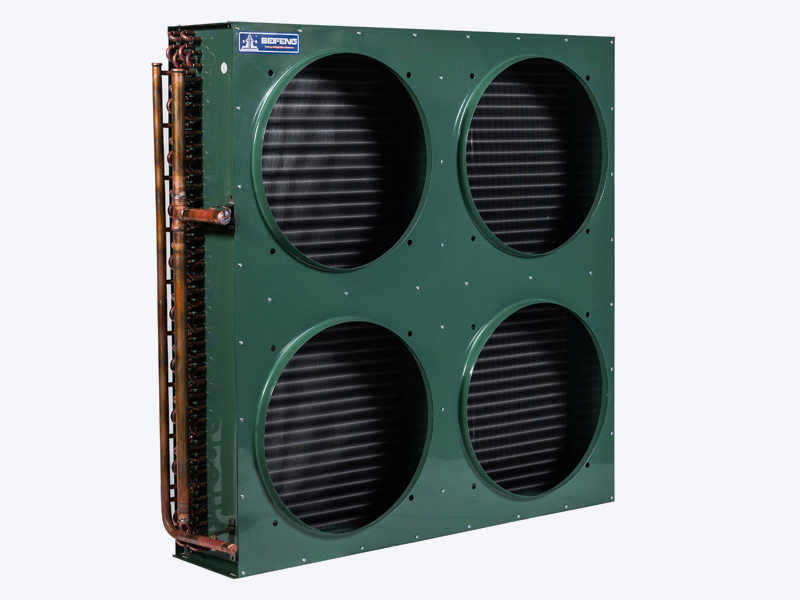
The role of an air cooled condenser is straightforward. It receives hot, high-pressure refrigerant vapor from the compressor discharge, condenses it into liquid, and rejects the heat to ambient air. There is no cooling tower, no cooling-water loop, and no chemical dosing. In normal operation, the heat-rejection side of the plant consumes zero water. That single fact changes the conversation with regulators, lenders, and sustainability teams.
The engineering trade-off is just as real as the water saving. Air cooling responds to dry-bulb temperature, so on a 40°C afternoon the condensing pressure climbs and compressor power follows. A water-cooled tower tracks wet-bulb conditions and often delivers a lower lift at that moment, but the comparison is rarely as one-sided as a single peak hour suggests. On hot, humid days the tower degrades as well, and when the full year is counted—nights, winters, and the many hours below design ambient—the air-cooled plant narrows the gap considerably. Add water treatment, discharge permitting, and tower maintenance to the ledger, and air-cooled frequently delivers the better total cost of ownership over a long asset life.
| Consideration | Air-Cooled Condenser | Water-Cooled Tower Loop |
|---|---|---|
| Water consumption | Zero in normal operation | Continuous makeup and blowdown |
| Chemical treatment | Not required | Biocides and scale inhibitors |
| Peak-hour efficiency | Lower on extreme hot days | Higher at peak wet-bulb conditions |
| Annual maintenance | Coil cleaning and fan checks | Water, fill, basin, and fan upkeep |
| Permitting complexity | Lower, no water discharge | Water rights and discharge permits |
| Cold-weather behavior | Free-cooling friendly | Freeze protection required |
| Facility footprint | Larger open area | Compact, with pump and piping |
Design Decisions That Define Real-World Performance
Once the air-cooled route is selected, real performance is set by a handful of decisions. The first is the condenser split—the temperature difference between condensing and ambient dry-bulb. A tighter split trims compressor power but requires a larger coil and more fan airflow; a wider split shrinks the hardware and inflates the energy bill for the life of the asset. Good projects evaluate both against the site's actual temperature profile.
Because data centers rarely run at full load, fan architecture is the second decision. A condenser with electronically commutated fans or variable-speed drives modulates airflow hour by hour. In cold months, the same control capability enables free-cooling and thermosyphon strategies that let the chiller rest when ambient air does the work.
Designing for the worst one percent of the year means paying for it in the other ninety-nine. A data center condenser should be selected from the annual temperature profile, not from one peak afternoon.
The third decision is placement. Hot-air recirculation erodes performance: when intake air comes from a neighboring unit's exhaust, effective ambient temperature rises, capacity falls, and the condenser works harder to achieve less. Generous separation, correct orientation to prevailing winds, and attention to walls and parapets are performance measures, not cosmetic details.
InfoFan power is the largest operating expense on the air side of the plant. At part load, reducing fan speed by 20 percent lowers fan power by roughly half.
Sizing and Selection: Where Projects Succeed or Stall
Selection mistakes appear in the first hot season and stay visible in every energy report afterward. A disciplined process typically follows six steps:
- Build the annual dry-bulb temperature profile. The design maximum matters, but part-load hours dominate the energy result.
- Agree on the design condensing temperature with the chiller supplier, because every condenser choice interacts with compressor lift.
- Verify coil face area and fan airflow at both design load and part load. Turndown capability matters as much as peak capacity.
- Match fin spacing to local air quality. Dense fins look efficient on paper but clog sooner in dusty environments.
- Check acoustic limits early. Fan diameter and tip speed, not just motor power, define the noise profile.
- Model the airflow around the condenser bank to prevent recirculation and keep intake temperatures at or below design value.
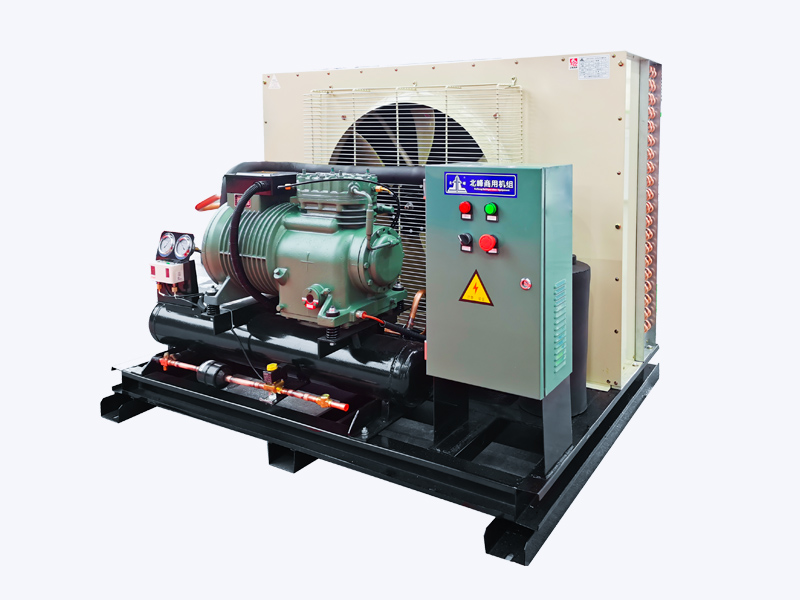
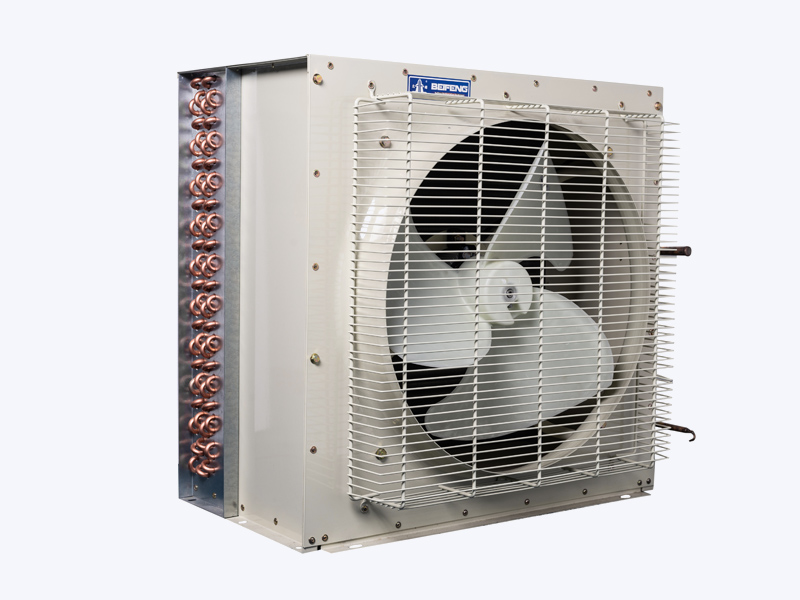
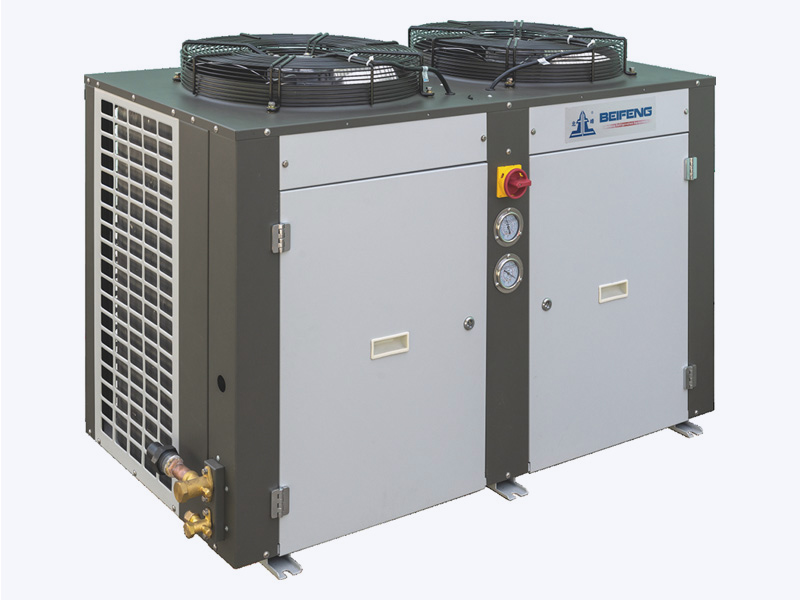
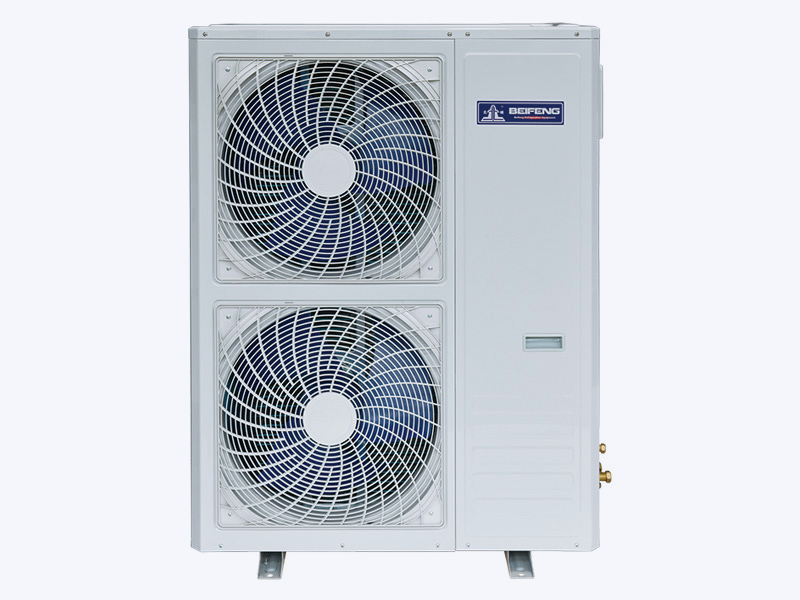
For packaged plants in the lower capacity band, most of this logic is already engineered into the unit. An air-cooled condensing unit combines compressor, coil, and fan array in one frame, which shortens design and installation for edge facilities and modular IT rooms.
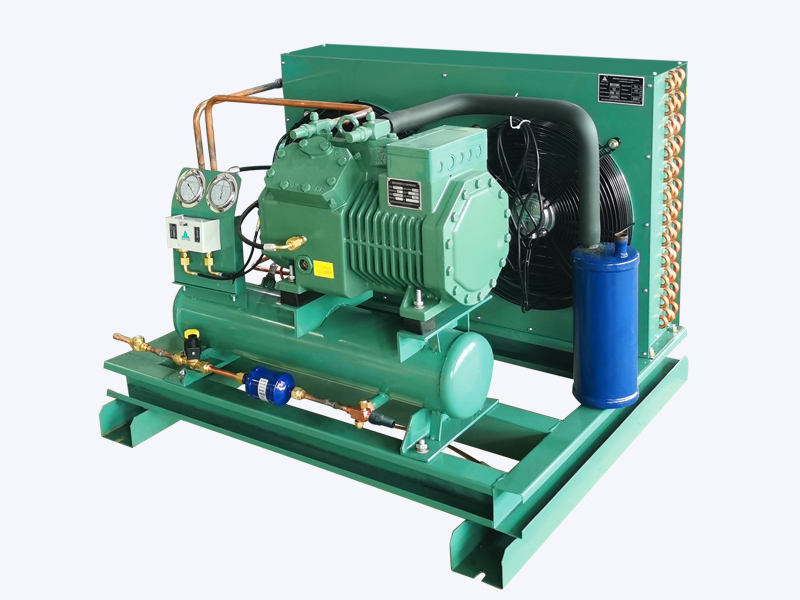 Semi-Hermetic Compressor Air-Cooled Condensing Unit (3HP-25HP)This packaged air-cooled condensing unit suits edge facilities and modular IT rooms in the lower capacity band, offering a compact, protected design with multiple refrigerant options and integrated safety components for simplified maintenance.View Product →
WarningPlacement mistakes cannot be corrected with more fans. Keep the recommended coil-intake clearance, and avoid recessing the condenser where buoyant exhaust is drawn back into the unit.
Reliability, Maintenance, and the Cost of Ownership
The maintenance story is where air-cooled systems win quietly. There is no water treatment regime, no basin cleaning, no drift eliminator inspection, no legionella management, and no freeze protection for water lines. The routine shifts to simpler disciplines:
- Clean or inspect coil fins according to the local fouling rate; soft brushing or low-pressure washing protects fin edges.
- Check fan bearings, belt tension, and motor currents on schedule; unexpected vibration is always an early signal.
- Monitor refrigerant charge through subcooling and condenser performance; a dirty or lightly charged system drifts long before it fails.
- Audit control settings and sensors so that variable-speed and free-cooling modes stay active instead of silently reverting to constant speed.
The operational advantages compound over time. A plant without chemical drums, blowdown lines, and water meters is simpler to operate, safer for technicians, and easier to extend when the data center grows.
SuccessIn moderate climates, a well-specified air-cooled condenser can match a water-cooled tower's efficiency across most operating hours—while consuming no water during normal operation.
Once installed, long-term reliability is decided by routine discipline. Following consistent air-cooled condenser maintenance practices—coil cleaning, fan checks, and control verification—delivers more uptime than any redundancy scheme added later.
DangerThe cardinal error is sizing from a summer peak alone. When the annual dry-bulb distribution is ignored, the plant ends up oversized, undersized, or badly matched for most of the year, and fixing it later costs many times the price of a proper analysis.
Matching the Condenser to the Whole Cooling Plant
An air-cooled condenser does not perform in isolation. Its capacity, staging, and control logic must align with the chiller's operating map, the refrigerant charge, and the facility's load profile. In multi-condenser banks, the sequence controller should distribute runtime evenly and call on only the coils needed at part load, so each unit works near its optimum instead of every unit cycling against a small load.
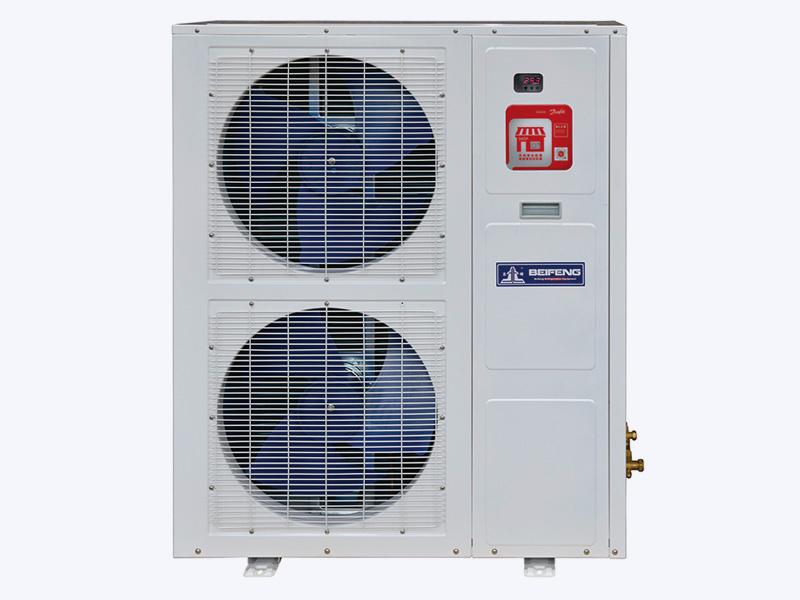
For projects that move beyond the packaged range, the same principles scale upward. Screw-type condensing units bring the packaged philosophy to higher capacities, bundling compressor and air-cooled heat rejection for facilities that consolidate several IT rooms into one central plant.
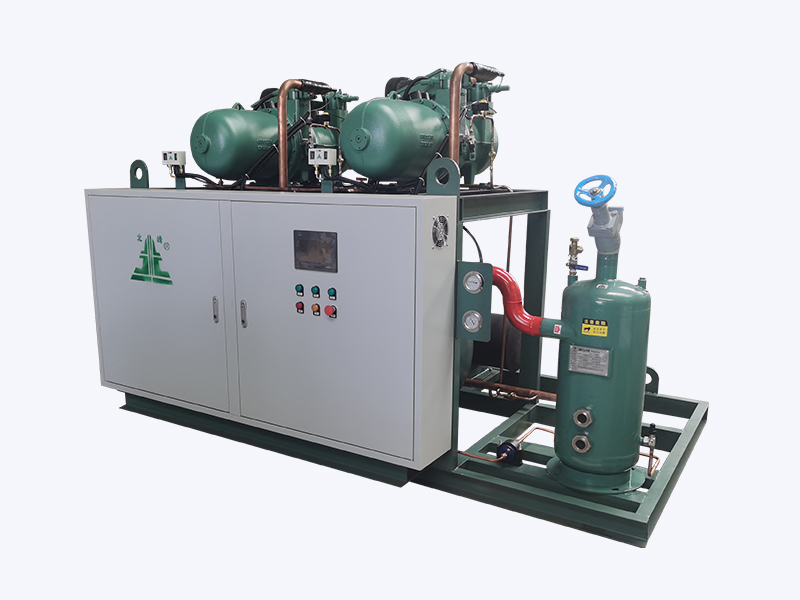 Screw-Type Condensing UnitFor central plants consolidating multiple IT rooms, this screw-type condensing unit extends air-cooled heat rejection to higher capacities. It offers multi-level energy adjustment, optional economizers, and intelligent controls for reliable, water-free operation.View Product →
The Air-Cooled Verdict
Air-cooled condensers are not a universal substitute for water-side heat rejection, and no responsible engineering team would claim otherwise. But the calculation has shifted in their favor. For data centers, where uptime, water risk, and operating cost are existential concerns, the ability to reject heat without a continuous water supply is a structural advantage. The technology is mature, the performance is predictable, and the list of reference installations grows every year.
For teams evaluating a new or expanded facility, the starting point is simple: model the annual ambient profile, compare total cost of ownership over at least ten years, and visit a reference plant that has run air cooling through several summers. The question is no longer whether air-cooled condensers can handle data center duty; it is how quickly the rest of the industry catches up with operators who already made the switch. If you are at that stage, compare your heat-rejection options with our engineering team and turn the analysis into a specification.
.jpg?imageView2/2/w/300/h/300/format/webp/q/75)