 English
 عربى
عربى 简体中文
简体中文
Home Comfort — Field Notes
A close look at what actually happens when you run an evaporative cooler versus a compressor-based unit in a room with nowhere for the air to go.
The Short Answer
In a fully enclosed room, an air cooler does not perform as well as a portable air conditioner. Evaporative cooling depends on a steady exchange of dry air — remove that exchange, and the effect collapses within the hour.
Air coolers work by pulling warm air through water-soaked pads; the water evaporates, absorbs heat, and the cooler air is pushed back into the room. It is the same principle behind a wet towel feeling cold in a breeze. But that evaporation needs somewhere for the resulting humidity to escape. Seal the room, and the air quickly saturates — the device stops cooling and starts humidifying instead.
Portable air conditioners avoid this problem entirely. They run a closed refrigeration loop, absorbing heat from indoor air and venting it outside through an exhaust hose. Because heat and moisture are physically removed rather than displaced, they deliver a consistent temperature drop regardless of how sealed or humid the room already is.
Evaporative cooling is a conversation with the outside air. Take the outside air away, and the conversation stops.
What Is an Evaporative Air Cooler
An evaporative air cooler is a device that draws warm air through water-soaked pads. As air passes through, the water absorbs heat and evaporates, and the resulting cooler, more humid air is circulated by an internal fan. Under ideal conditions — hot, dry ambient air — this can lower room temperature by 15 to 25°F (8–14°C).
The catch is that the process is entirely dependent on continuous air exchange. Without fresh, dry air replacing the humid air being released, evaporation slows, and the unit's effectiveness drops sharply.
Why ventilation matters
Manufacturers typically recommend keeping a window or door partially open when running an evaporative cooler indoors. This lets humid air escape and dry air enter, sustaining the cycle. Without it, the cooler's output falls off within thirty to sixty minutes.
How Portable Air Conditioners Cool Differently
Portable air conditioners use a closed refrigeration loop, much like a refrigerator. A refrigerant absorbs heat from indoor air, and a compressor cycles that heat outside through an exhaust hose vented through a window kit. Because the heat and moisture leave the room entirely, these units don't depend on outdoor humidity or airflow to function — they can lower temperature by a steady 10 to 15°F, even in a sealed, humid space.
Air coolers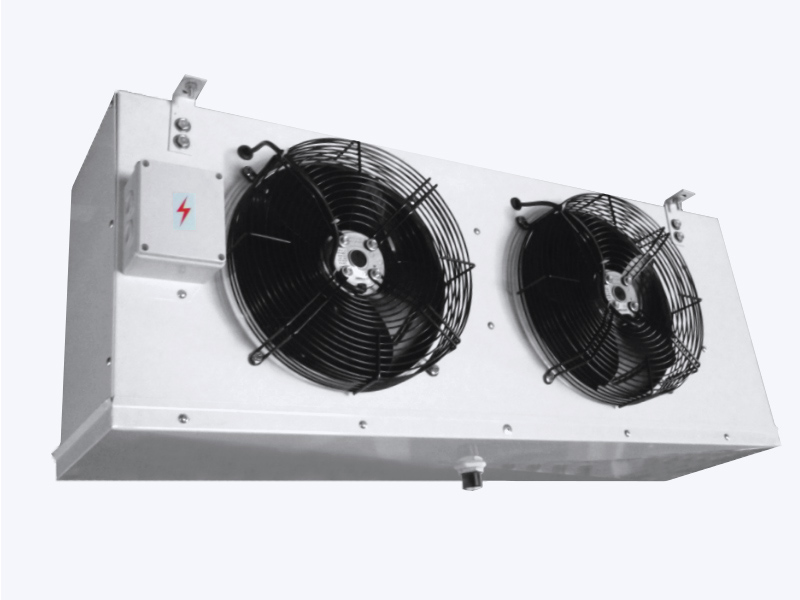
The tradeoff: they need a sealed exhaust path, draw considerably more electricity, and are heavier and less mobile than an air cooler. Compressor noise is also more noticeable, though newer units have narrowed that gap.
Side-by-Side in an Enclosed Room
The comparison below reflects performance specifically in a closed, low-ventilation space — the scenario most relevant to interior bedrooms, small offices, and apartments without central air.
| Factor | Air Cooler | Portable Air Conditioner |
|---|---|---|
| Temperature drop in sealed room | 2–5°F, often less | 10–15°F, consistently |
| Humidity impact | Increases room humidity | Reduces room humidity |
| Ventilation requirement | Needs an open window or door | Needs a sealed exhaust hose only |
| Energy consumption | 100–200 watts | 900–1500 watts |
| Portability | Very light, easy to move | Heavier, needs window access |
| Noise level | Generally quieter | Louder, due to compressor |
Where it breaks down
In a sealed room, an air cooler's cooling effect can all but disappear within an hour — the enclosed scenario plays directly to the strengths of compressor-based cooling and exposes the core limitation of evaporative technology.
How to Use an Evaporative Air Cooler Well
If you already own an air cooler, or prefer its lower running cost, there are ways to get closer to its rated performance even in a room that isn't perfectly ventilated. Knowing how to use an evaporative air cooler properly makes a real difference.
- Crack a window or door on the opposite side of the room to create genuine airflow rather than trapping humid air.
- Position the unit near the fresh-air source — a window or hallway — rather than tucked in a corner.
- Refill the water tank regularly; dry pads stop the evaporation process entirely.
- Run the unit during the hottest, driest part of the day, when ambient humidity is lowest.
- Clean or replace cooling pads each season to prevent mineral buildup and mold.
- Avoid using it in already-humid rooms, such as basements or bathrooms — it will worsen comfort, not improve it.
The payoff
Followed consistently, these steps won't turn an evaporative cooler into a refrigeration system — but they will bring it much closer to its rated cooling capacity.
Energy Cost and Long-Term Running Expense
An evaporative cooler typically draws 100 to 200 watts, comparable to a large fan. A portable air conditioner sized for a bedroom or small office usually draws 900 to 1500 watts. Over a full cooling season, that gap adds up — especially where cooling is needed for months at a time.
But cost only matters if the device actually solves the problem. In an enclosed room, an air cooler's lower price may not be worth it if it simply can't deliver enough cooling. Running the air conditioner for fewer hours a day, or reserving the air cooler for well-ventilated spaces, is often the more practical middle ground.
Which Rooms Are Enclosed Enough to Matter
Not every room is sealed to the same degree, and that distinction shapes which device makes sense.
Where air coolers struggle most
Interior bedrooms with no window, basement rooms with limited circulation, and small offices with sealed doors are where evaporative cooling performs worst — humidity has nowhere to escape, and the effect can vanish within the hour.
Where air coolers can still hold up
A partially open window, a hallway with airflow, or a ceiling fan aiding circulation can let an evaporative cooler maintain a usable 8 to 12°F drop — even in a room that isn't fully open.
A common mistake
Running an air cooler in a fully sealed room and expecting air-conditioner-level results is the single most common source of disappointment with these units.
The Practical Takeaway
For a fully sealed bedroom, home office, or apartment without natural ventilation, a portable air conditioner is the dependable choice — it doesn't rely on external air exchange to work. For a garage, workshop, or covered patio with a window that can stay open, an evaporative air cooler is a lower-cost, energy-efficient option that delivers real relief, particularly in dry climates.
If the room is used for sleeping or long stretches in hot weather, the air conditioner remains the safer investment for consistent, humidity-independent cooling. The air cooler earns its place where airflow is a given, and its lower cost and simplicity outweigh the need for maximum temperature drop.
.jpg?imageView2/2/w/300/h/300/format/webp/q/75)